Triple-Pane Windows in the Real World: What Happens When High-Performance Design Meets On-Site Installation
Spotlight on Quarve Contracting | Minneapolis, MN
The Wise Window Hub spoke with Dan Handeen, a homeowner and building science researcher with more than 20 years of experience studying window performance, and Greg Burger, Field Operations Supervisor at Quarve Contracting, who oversaw the installation. Together, their perspectives offer a rare, full-circle look at how triple-pane windows perform -- from design intent to jobsite realities to everyday living.
Take this story with you. Download now!
A Longtime Believer, Finally a First-Time User
Dan Handeen has been teaching, researching, and writing about window performance for decades. As an architecture instructor and researcher focused on high-performance residential construction, triple-pane windows are not a new concept to him.
“I’ve been aware of triple-pane windows and their benefits for about 20 years,” Dan says. “But this was the first time I actually installed them in a home I own.”
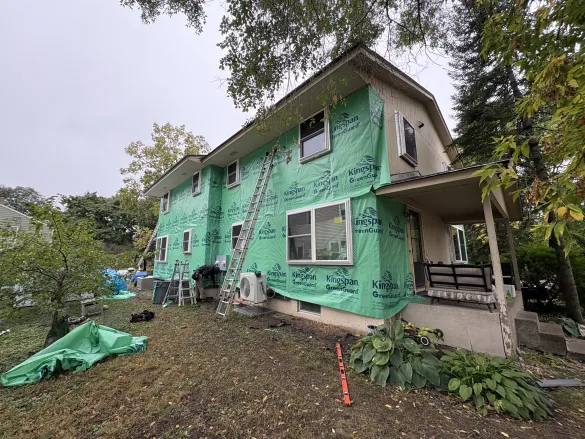
The timing mattered. Dan’s project combined triple-pane window replacement with continuous exterior insulation (CEI), an approach that addresses thermal bridging and moisture risk by moving more of the insulation outside the wall structure. Doing one without the other didn’t make sense.
“If I was going to do the exterior insulation, I wasn’t going to keep the old windows,” he explains. “And I wasn’t going to install new windows without addressing the walls.”
Incentives also played a role. Dan is candid that without financial support, the upgrade might have stayed theoretical.
“The upcharge for triple-pane ended up being about 7% of the total window cost, roughly $150 per window,” he says. “I probably wouldn't have done triple-pane if it wasn't for the HPW incentive, quite honestly.”
From the Installer’s Side: Heavier, Not Harder
Greg Burger has spent more than 30 years in construction, including decades installing windows by hand before moving into field supervision. While this was Quarve’s first triple-pane project paired with deep exterior insulation, triple-pane windows themselves were familiar territory.
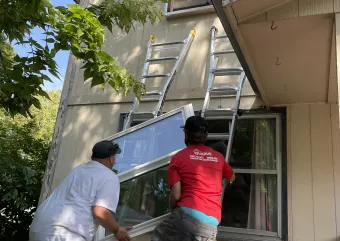
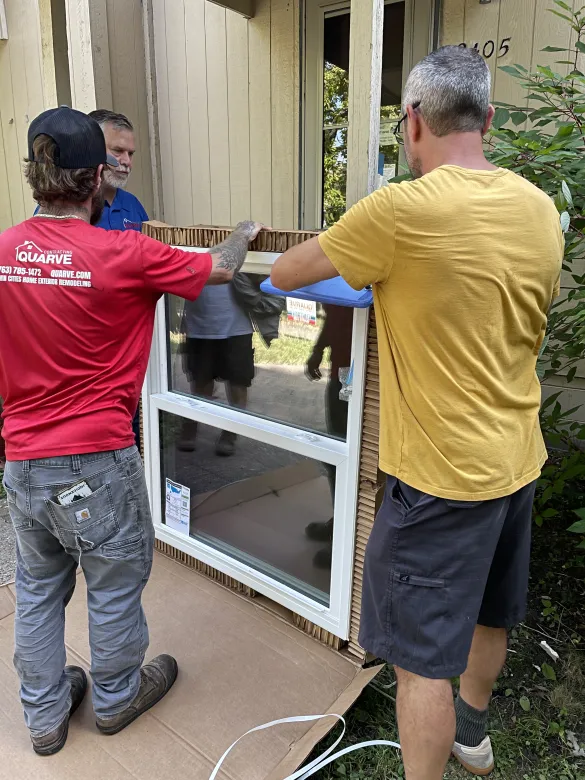
“They’re heavier; installers notice that right away,” Greg says. “But the installation process is basically the same as double-pane. You just need to be more mindful of handling, especially on larger units.”
For standard-sized windows, Greg notes that experienced installers can still work efficiently. Larger window groupings may require additional crew support, but not a fundamentally different skill set.
“The biggest thing is making sure everything is level, flashed correctly, and detailed right,” he says. “That matters no matter what kind of window you’re putting in.”
Greg also emphasized the importance of hands-on training. On this project, he walked crews through each step before letting them take the lead.
“I like to demonstrate first, then guide them through it,” he says. “That’s how you make sure details don’t get missed.”
Performance That Shows Up Immediately
While energy savings are often the headline metric for high-performance windows, Dan noticed something else first: quiet.
“I live on a busy street,” he says. “Before, I could tell what kind of vehicle was going through the intersection, even from the bedroom on the opposite side of the house. That’s gone." Greg heard the same feedback on site. “Dan noticed the noise reduction right away,” he says. “That’s something customers consistently comment on with triple-pane.”
Thermal comfort followed closely behind. Drafts disappeared. Sitting near windows became comfortable again. During a late-season heat wave, Dan noticed his air conditioning barely ran, all thanks to reduced air leakage and low-E coatings limiting unwanted heat gain.
“These are things you feel every day,” Dan says. "The house seems to maintain temperature better. It doesn't feel like there's quite the same variation. When I wake up in the morning it'll be cool, but not frigid like the way it used to be."
Lessons from the Field: Details Matter
This project also highlighted a critical reality: high-performance products only perform as intended when installation details are executed correctly. Because the windows were “furred out” to align with thick exterior insulation, detailing became more complex, especially around flashing, drainage, and penetrations. Dan ultimately handled much of the penetration management himself, ensuring that water would be directed safely back out of the wall assembly.
“If you don’t manage water correctly, none of the insulation or air sealing matters,” he says. “That’s building science 101.”
Both Dan and Greg point to training and communication as key challenges, and opportunities, for the industry. Mock-ups, clear installation sequences, and hands-on learning can help bridge the gap between design intent and jobsite execution.
Despite the learning curve, both homeowner and installer agree: triple-pane windows deliver real value. From Greg’s perspective, customer satisfaction speaks for itself. “People notice the comfort and the quiet,” he says. “That’s usually what they talk about first.” For Dan, the benefits go beyond energy modeling.
“I don’t expect this project to pay for itself through energy savings alone,” he says. “But comfort, reduced noise, and how the house feels every day, that’s worth something. Those benefits are real, even if they’re harder to quantify.”