Working Together: Volunteer Perspectives on Triple-Pane Windows in the Twin Cities
Spotlight on the Twin Cities Habitat for Humanity | Maplewood, MN
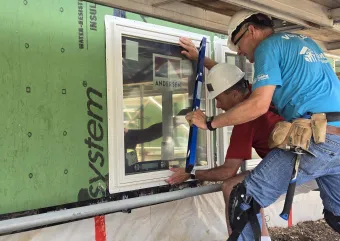
The Wise Window Hub and the Twin Cities Habitat for Humanity came together in the summer of 2025 to convene at the Maplewood MN Twin Cities Habitat demonstration site to give volunteers and staff alike the chance to work hands-on with Andersen 400 Series triple-pane ENERGY STAR® windows.
Volunteer Perspectives on Triple-Pane Windows
During this particular demonstration, this was the first time installing this type of high-performance window. Two voices stand out from the build: Val McCampbell, a Habitat construction assistant who guided volunteers through the installation, and Clarke Porter, a longtime Habitat volunteer who came to the project eager to learn new skills. Together, their experiences reveal how advanced window technology can fit seamlessly into volunteer-driven construction and why it matters for the families moving into these homes.
Val joined Habitat a little over a year ago after training in carpentry and spending more than a decade in conservation work. Their previous window experience was mostly with the Andersen 100 Series, but this was their first opportunity to work with the heavier, triple-pane 400 Series. “The main difference was the weight and rigidity,” they explained. “The 400 Series is a lot more solid.” Volunteers paid particular attention to the installation flanges while handling due the added weight of the triple-pane product. Mechanically, the process to install the triple-pane products was the same as with a standard double-pane product.
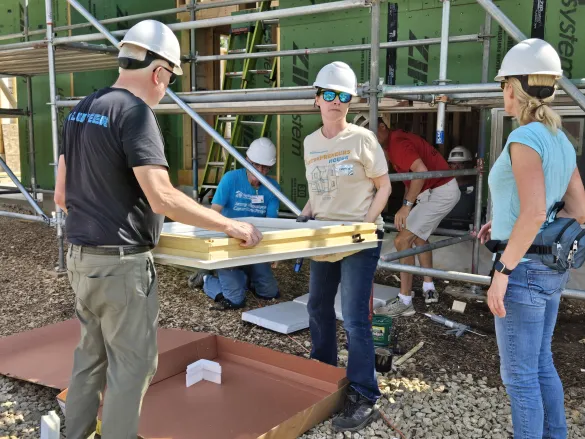
Despite those differences, Val was surprised by how smoothly the process went once the windows were in position. “With three people on a team - two outside and one inside - we were able to lift, shim, and secure the windows without much trouble,” they said. “After we got one in and leveled, the volunteers pretty much took off on their own. I’d check in, but they didn’t need much from me after that.”
For Clarke, who had been volunteering with Habitat for years, this was his first time installing windows of any kind. The triple-pane models left a strong impression. “The first thing I noticed was how quiet it got inside once we put them in,” he said. “We were joking about being in a cone of silence because you really couldn’t hear much once the windows were in place.” That soundproofing, along with the visible attention to sealing and insulating, drove home the performance difference for him. “You could tell right away these are built to keep the heat in and the drafts out. That’s going to make a huge difference for the families who live here.”
Val also pointed to small design details that made the 400 Series easier to integrate into a project, stating “Both sashes come out, which is a big plus during construction.” They also noted that the use of zip sheathing simplified flashing and waterproofing compared to past projects. “We just taped and sealed, and it went really quickly. It’s definitely a more efficient way of finishing.”
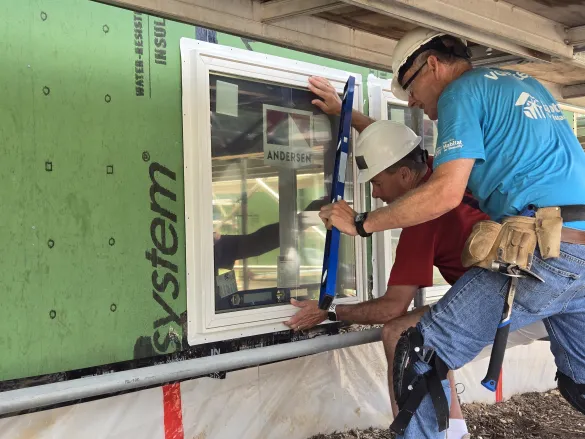
Both Val and Clarke emphasized how manageable the process was for volunteers with limited experience. “A lot of people had never touched a window before, but by the end of the day they were confident,” Val said. “That’s the best part for me, watching someone go from not knowing what to do to installing a window on their own. With a little guidance, it’s totally possible.” Clarke echoed that point: “I came in with no idea how to install a window, and now I feel like I could do one at home. That’s a pretty cool feeling.”
When it came to whether triple-pane windows were worth the investment, both participants leaned toward yes. Clarke reflected on the comfort they would provide: “If you’re a family moving in here, you’re going to notice right away that it’s quieter and warmer. That’s a big deal.” Val agreed, noting the long-term savings. “I don’t make the purchasing decisions,” they said, “but if you’re talking about durability, energy efficiency, and lowering utility costs for homeowners, these windows are a huge upgrade. They’re going to last, and they’re going to perform.”
The Maplewood MN Twin Cities Habitat for Humanity project showed that even advanced, high-performance technology like triple-pane windows can be installed successfully in a volunteer-driven environment when clear training and teamwork are in place. When it comes to builders and contractors that have installed windows (and even for those that haven't), no changes are needed to standard building practices to go to triple-pane windows; we call this the "drop-in upgrade."
For Val, it was a chance to strengthen their teaching and installation skills. For Clarke, it was an opportunity to learn something new and to witness the impact of better technology firsthand. And for the families moving into these homes, it’s the promise of greater comfort, minimize energy burden on occupants, and long-lasting quality.
As Clarke put it: “At the end of the day, I didn’t just help put in a window, I helped make this house a home. And knowing those windows are going to keep a family comfortable for years, that’s something I’ll remember.”